Making AI-Built Software Actually Ship Right
Coding agents build fast and drift faster. Features that were never written down never get built, several people prompting the same codebase produce conflicting work, and nobody can verify what was delivered against what was agreed. The cost is not speed, it is rework.
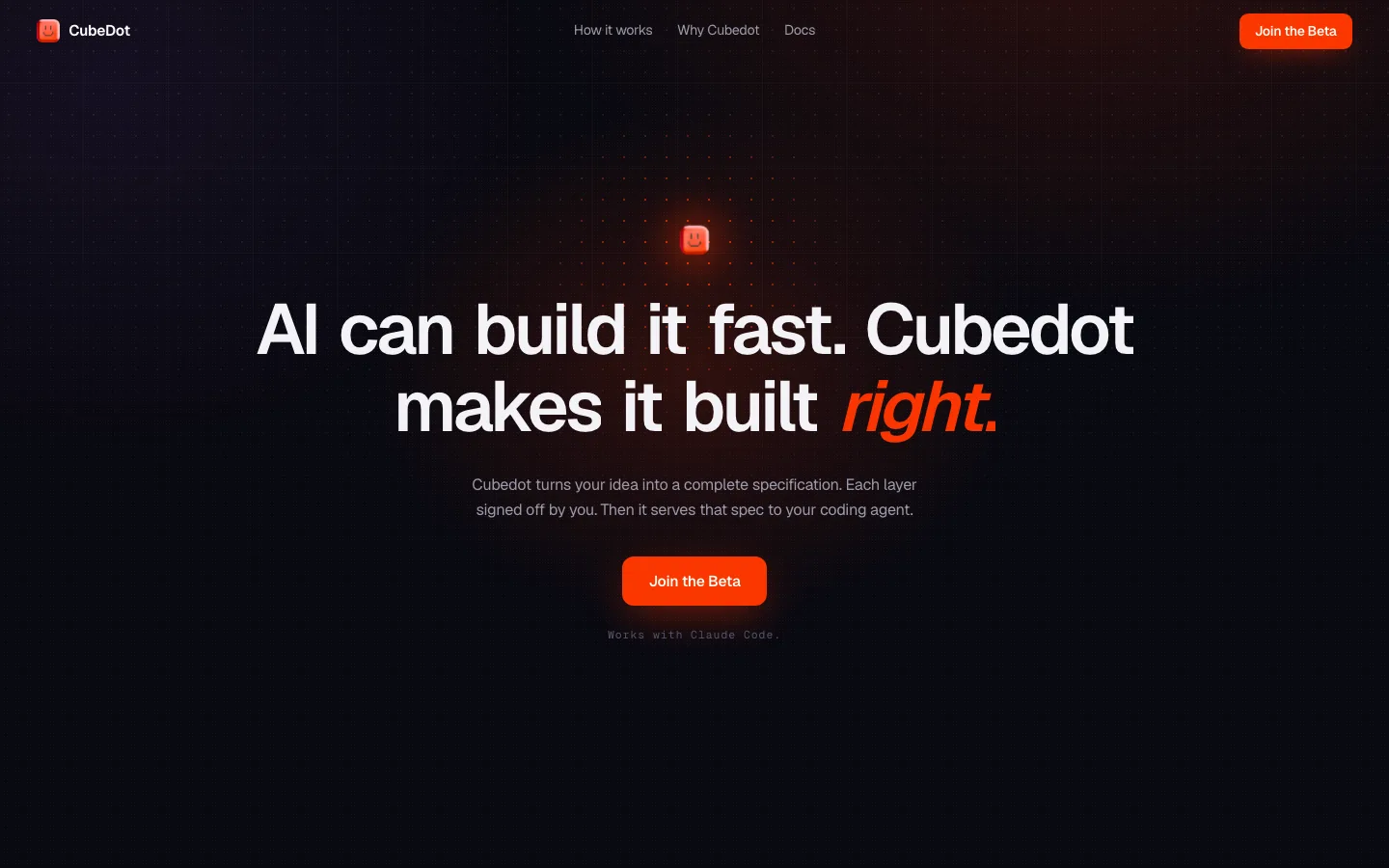
The Challenge
Coding agents build fast, and they drift just as fast. A feature nobody wrote down never gets built. Two people prompting the same codebase produce work that conflicts in ways neither of them notices until later. And when something is delivered, there is no straightforward way to check it against what was actually agreed, because what was agreed lives in a chat log. The cost of this does not show up as slow development. It shows up as rework, which is more expensive and much harder to see coming.
What We Built
Cubedot turns a product idea into a complete specification across eight layers, covering the brief, features, tech stack, wireframes, database, risks, sequencing and design. Each layer is approved before the next is generated, so a wrong assumption gets caught while it is still one paragraph rather than after it has been built on. That spec is then served to the coding agent through an MCP server, and the delivered work is independently verified against the acceptance criteria the spec already defined.
Decisions Worth Explaining
Approval gates between layers
Generating all eight layers at once would be faster and would mostly produce a document nobody reads. Gating each layer forces the decisions to be looked at in the order they actually depend on each other, which is the only point where correcting them is cheap.
Verification separate from generation
Asking the agent that wrote the code whether the code is correct produces an optimistic answer. Checking the work against acceptance criteria written before the code existed is the only version of that check worth running.
MCP rather than a bespoke integration
Serving the spec over MCP means the context reaches the agent through a channel the agent already understands, instead of relying on someone remembering to paste the right document into the right prompt.
The Result
The platform is in beta, integrated with Claude Code over MCP, with Jira and Figma connections and an audit trail a non-technical stakeholder can read without a translator.
Under the Hood
Spec generation across brief, features, tech stack, wireframes, database, risks, sequencing and design, with approval gates at each layer. Deep Claude Code integration over an MCP server, plus Jira and Figma connections and an audit trail non-technical stakeholders can actually read.
Technology Stack
Want Similar Results?
Let's discuss how we can help solve your technical challenges.